
Early Math & Mathematical Thinking
Blooming Prep Family Resources
Introduction
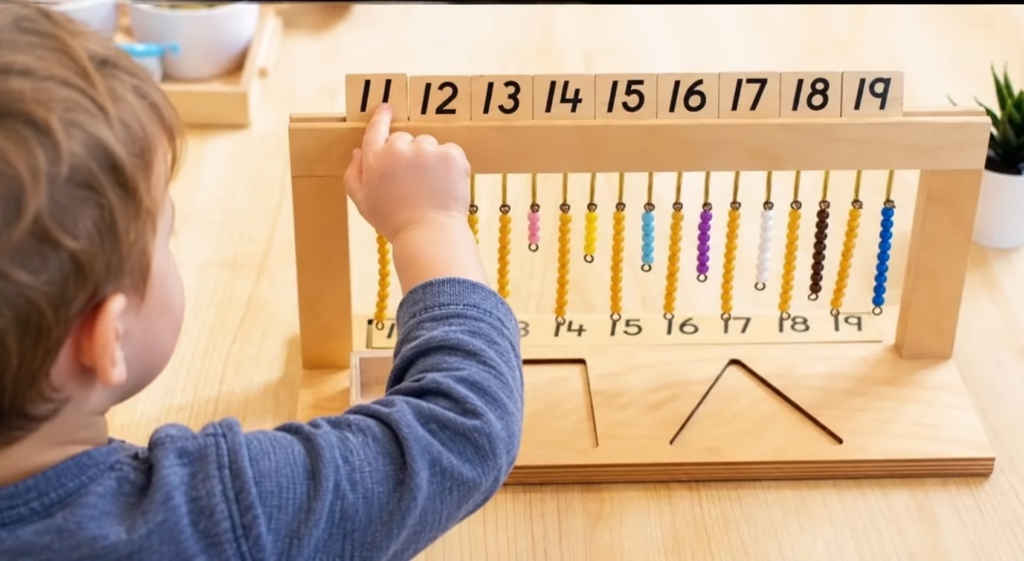
Mathematical thinking begins much earlier than many people realize. Research has shown that infants and toddlers naturally develop foundational math skills through everyday experiences as they explore, observe, compare, sort, and interact with the world around them. Young children build mathematical understanding through hands-on experiences rather than formal instruction. Activities such as stacking blocks, sorting objects, identifying patterns, comparing sizes, recognizing shapes, counting everyday items, and exploring nature all contribute to early mathematical development.
Supporting Mathematical Thinking at Home
- Count objects together during play and routines.
- Compare quantities using words such as more, less, bigger, and smaller.
- Identify shapes found in the environment.
- Sort toys, leaves, shells, or household objects by color, size, or type.
- Create and recognize simple patterns.
- Build with blocks and other open-ended materials.
- Explore measurement while cooking or gardening.
- Encourage problem-solving during play and daily activities.
Mathematical Concepts Young Children Explore
- Number sense
- Counting skills
- Pattern recognition
- Sorting and classification
- Shape recognition
- Spatial awareness
- Measurement concepts
- Logical reasoning
- Problem-solving abilities
Learning Through Play
Play provides meaningful opportunities for children to explore mathematical concepts naturally. Activities involving building, art, music, movement, nature exploration, sensory experiences, and imaginative play all support the development of mathematical thinking.
Recommended Resources for Families
Organizations:
- National Association for the Education of Young Children (NAEYC)
- Zero to Three
- Erikson Institute Early Math Collaborative
Children’s Books:
- Ten Black Dots – Donald Crews
- Fish Eyes: A Book You Can Count On – Lois Ehlert
- 1, 2, 3 to the Zoo – Eric Carle
- Goodnight Moon – Margaret Wise Brown
- Ten Little Monkeys Jumping on the Bed – Eileen Christelow
A Final Thought
Mathematics is not simply about numbers. It is a way of thinking, reasoning, exploring, and making sense of the world. By encouraging curiosity, observation, and problem-solving through everyday experiences, families can help young children develop a strong foundation for future learning.